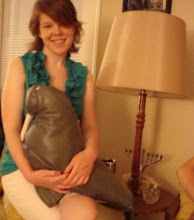
Last week felt so long... not because it eeked by, but because the days were so packed. Clyde went to and was released from the hospital, I had my first lunch with my study buddy, Interfaith Youth Core came from Chicago for training, my zoomie Greg led worship on Thursday, and I attended the College Board of Trustees meetings on Friday. Oh, and I made something like five dozen cupcakes. And we volunteered at the animal shelter after making a crazy vegan Valentine's brunch of biscuits and gravy, eggless frittata with asparagus and sundried tomatoes, and seven-spice potatoes. And there was Team WECI Basketball. Not to mention all that time spent helping/cheering along Nathaniel with his application. And the 100-mi radius potluck last night. And I co-taught first-day school yesterday in preparation for going-it-alone in March. Sigh! I'm gonna stop before I remember anything else. :)
Unfortunately I did not get much done in the way of thesis work. It was very much one of those weeks where I allowed myself to get pulled hither and thither with extra-curricular activity and did not take time to ground myself in my studies. Heck, I didn't even make class Thursday morning because I was so sleepless Wednesday night. I'm recommitting to my work this morning... getting up and out at 8:45 was a good start. I'm about to clean off the whiteboard and make my weekly calendar before listing a bunch of books for sale online. I desperately need cash and am thinking of getting back into, actually.
Monday, February 16, 2009

Wednesday, November 12, 2008
joint letter of AFSC and FCNL
from the American Friends Service Committee (afsc.org) and Friends Committee of National Legislation
November 7, 2008
Condoleezza Rice
Secretary of State
U.S. Department of State
2201 C Street NW
Washington DC, 20520
Dear Secretary Rice,
We are deeply concerned about the crisis in the Democratic Republic of the Congo’s
North Kivu province. As you know, the recent surge in violence, sparked by fighting
between the CNDP rebel forces, local militias, and the DR Congo’s national army, has
displaced tens of thousands and led to widespread killings, looting, and distressing human rights abuses, including sexual and gender based violence. We are alarmed by the lack of humanitarian access to the tens of thousands of Congolese civilians who fled the recent violence and the continued insecurity that has led to the reevacuation of many aid groups working to assist them. While U.N. agencies stepped up efforts to deliver assistance earlier this week, tens of thousands of civilians are still without shelter, and many lack access to food and clean water. While the cease-fire is holding in Goma, reports indicate fighting has resumed in other
parts of North Kivu. U.S. resources and attention from the most senior levels are needed urgently to protect civilians and prevent a further escalation of the crisis.
In coordination with ongoing diplomatic efforts by the newly appointed U.N. special
envoy, the French, British, and engaged African countries, and building on Assistant
Secretary Jendayi E. Frazer’s recent visit to Kinshasa, we urge you to:
• Appeal to all armed actors to immediately cease hostilities.
• Prevail on all parties to allow unfettered access for humanitarian relief assistance
to civilians who have been forced to flee their homes and communities.
• Urge all countries to halt the supply of weapons to armed parties.
• Persuade all armed groups in North Kivu to fully participate in the comprehensive
disengagement plan, including the separation of forces and brassage processes.
• Support the convened negotiations in Nairobi to include all actors in order to
review their responsibilities under previously signed agreements, notably the
November 2007 Nairobi Communiqué and the January 2008 Goma Peace
Accords.
• Work with Security Council Members, the U.N. Department of Peacekeeping
Operations and UN member countries to improve the capacity of the U.N.’s
FRIENDS COMMITTEE ON NATIONAL LEGISLATION peacekeeping operation in the DRC (MONUC) to better protect civilians and create space for the provision of humanitarian assistance.
• Increase efforts to find long-term and non-military solutions in the eastern DRC,
including an increase in civilian capacities on the ground to undertake important
work in areas such as community policing, justice and reconciliation, and broadbased
development.
Fighting and unspeakable atrocities have continued in the DRC for far too long.
Promoting a sustainable peace, protecting civilians, and providing humanitarian relief can be achieved with these recommended steps. We appreciate your immediate attention and support your leadership role in addressing the urgent crisis in Congo.
Sincerely,
Mary Ellen McNish
General Secretary
American Friends Service Committee
Joe Volk
Executive Secretary
Friends Committee on National Legislation (Quakers)
CC: Assistant Secretary Jendayi E. Frazer, Africa Bureau, US State Department
November 7, 2008
Condoleezza Rice
Secretary of State
U.S. Department of State
2201 C Street NW
Washington DC, 20520
Dear Secretary Rice,
We are deeply concerned about the crisis in the Democratic Republic of the Congo’s
North Kivu province. As you know, the recent surge in violence, sparked by fighting
between the CNDP rebel forces, local militias, and the DR Congo’s national army, has
displaced tens of thousands and led to widespread killings, looting, and distressing human rights abuses, including sexual and gender based violence. We are alarmed by the lack of humanitarian access to the tens of thousands of Congolese civilians who fled the recent violence and the continued insecurity that has led to the reevacuation of many aid groups working to assist them. While U.N. agencies stepped up efforts to deliver assistance earlier this week, tens of thousands of civilians are still without shelter, and many lack access to food and clean water. While the cease-fire is holding in Goma, reports indicate fighting has resumed in other
parts of North Kivu. U.S. resources and attention from the most senior levels are needed urgently to protect civilians and prevent a further escalation of the crisis.
In coordination with ongoing diplomatic efforts by the newly appointed U.N. special
envoy, the French, British, and engaged African countries, and building on Assistant
Secretary Jendayi E. Frazer’s recent visit to Kinshasa, we urge you to:
• Appeal to all armed actors to immediately cease hostilities.
• Prevail on all parties to allow unfettered access for humanitarian relief assistance
to civilians who have been forced to flee their homes and communities.
• Urge all countries to halt the supply of weapons to armed parties.
• Persuade all armed groups in North Kivu to fully participate in the comprehensive
disengagement plan, including the separation of forces and brassage processes.
• Support the convened negotiations in Nairobi to include all actors in order to
review their responsibilities under previously signed agreements, notably the
November 2007 Nairobi Communiqué and the January 2008 Goma Peace
Accords.
• Work with Security Council Members, the U.N. Department of Peacekeeping
Operations and UN member countries to improve the capacity of the U.N.’s
FRIENDS COMMITTEE ON NATIONAL LEGISLATION peacekeeping operation in the DRC (MONUC) to better protect civilians and create space for the provision of humanitarian assistance.
• Increase efforts to find long-term and non-military solutions in the eastern DRC,
including an increase in civilian capacities on the ground to undertake important
work in areas such as community policing, justice and reconciliation, and broadbased
development.
Fighting and unspeakable atrocities have continued in the DRC for far too long.
Promoting a sustainable peace, protecting civilians, and providing humanitarian relief can be achieved with these recommended steps. We appreciate your immediate attention and support your leadership role in addressing the urgent crisis in Congo.
Sincerely,
Mary Ellen McNish
General Secretary
American Friends Service Committee
Joe Volk
Executive Secretary
Friends Committee on National Legislation (Quakers)
CC: Assistant Secretary Jendayi E. Frazer, Africa Bureau, US State Department
Monday, July 14, 2008
mon 14 july 08: cleaning, cookies, genocide
today i interspersed my house-cleaning and baking cookies with continuing to read philip gourevitch's we wish to inform you that tomorrow we will be killed with our families, an account of the rwandan genocide of 1959-1996. (it's inadequate to simply write 1994, which marked the height--but not the extent--of the extermination campaign.) i started reading when i woke up, with my fuzzy morning brain, and picked it up again during breaks--lunch, while waiting for a mopped floor to dry, etc. it was an uncomfortable feeling, attending to this solidly middle class life of scented candles, carpet refresher, & houseplants while reading about a boy who carried a double bed on his head as he fled his native land, or a woman who lost her entire family to a man and his machete, only to find the killer return from exile to inhabit next-door. (303 "A certain Girumuhatse is back") a chief in the resistance who operates from his 'office' of a gazebo covered with UN plastic sheeting: "'Truly, he said, 'the Hutus want to exterminate all the Tutsis.' His own people, too where having a hard time protecting themselves: their fighters included boys of six and seven, and their arsenal consisted largely of spears, bows, and arrows, and homemade rifles that fired nails. 'It's not an automatic,' the Mwami said of such a gun, 'but it kills.'" (288) not cognitive dissonance proper, no, but it gave me an unsettled pause nonetheless.
middle-class frivolities abounded later this evening, when i started baking vegan chocolate chip cookies for my boyfriend and his roommate arthur. for brian's i bought a special bar of fair-trade chocolate--he admirably rejects the blood variety (learn more here)--and used fair-trade dark brown sugar. i spent at least an hour reading and researching recipes and the results, thus far, have been divine. i'm letting the cookies rest in the fridge for 12, 24 hours and then sprinkling the tops with sea salt--this may be my new "secret". the cookies are a bit overly sweet (even with 70 per cent chocolate) so the salt should counterbalance. sweet + salty is ne'er a miss, though, from normandy's savoury sablé to french fries dipped in wendy's frosties.
middle-class frivolities abounded later this evening, when i started baking vegan chocolate chip cookies for my boyfriend and his roommate arthur. for brian's i bought a special bar of fair-trade chocolate--he admirably rejects the blood variety (learn more here)--and used fair-trade dark brown sugar. i spent at least an hour reading and researching recipes and the results, thus far, have been divine. i'm letting the cookies rest in the fridge for 12, 24 hours and then sprinkling the tops with sea salt--this may be my new "secret". the cookies are a bit overly sweet (even with 70 per cent chocolate) so the salt should counterbalance. sweet + salty is ne'er a miss, though, from normandy's savoury sablé to french fries dipped in wendy's frosties.
Saturday, July 12, 2008
sat 12 july 08: jamie stewart
jamie stewart, lead singer of my favorite band xiu xiu, keeps a blog at http://xiuxiu.org/ that i visit not infrequently. today i enjoyed this bit:
(I already typed this once, but I accidentally pulled the plug out of
my ancient laptop whilst chasing a moth around my bedroom and now I
can't really remember what I said... maybe the moth was sent to
prevent me from making an idiot of myself via the internet ((again??))
It happens too much. The Moth is dead now and I am full of guilt!)
and
favorite device that makes sound is probably my viola ...
my favorite creatures what make sound are my cats. my cat Nani meeps and mews to wake me up in the morning and purrs near face before we fall asleep. Osgrr, cat #2, barks and quacks - he is a supreme weirdo cat.
my favorite place is the house i live in and the thugs that live in it - they both collectively and respectively all make such good noisy conversational music.
My favorite thing that makes sound was my cat Harry, he was a talker and would meow perpetually until he was fed or got attention. This ment he doubled as a great alarm clock and sometimes as a good excuse to get out of a two hour phone call from aunt Mildred. Alas he died last month so I had to buy a real alarm clock, the alarm clock's shit at keeping me warm and loving me though thus far.
(I already typed this once, but I accidentally pulled the plug out of
my ancient laptop whilst chasing a moth around my bedroom and now I
can't really remember what I said... maybe the moth was sent to
prevent me from making an idiot of myself via the internet ((again??))
It happens too much. The Moth is dead now and I am full of guilt!)
and
favorite device that makes sound is probably my viola ...
my favorite creatures what make sound are my cats. my cat Nani meeps and mews to wake me up in the morning and purrs near face before we fall asleep. Osgrr, cat #2, barks and quacks - he is a supreme weirdo cat.
my favorite place is the house i live in and the thugs that live in it - they both collectively and respectively all make such good noisy conversational music.
My favorite thing that makes sound was my cat Harry, he was a talker and would meow perpetually until he was fed or got attention. This ment he doubled as a great alarm clock and sometimes as a good excuse to get out of a two hour phone call from aunt Mildred. Alas he died last month so I had to buy a real alarm clock, the alarm clock's shit at keeping me warm and loving me though thus far.
Friday, July 11, 2008
fri 11 july 08: italo calvino
"dream-like story-telling at the twilight of an empire" advertises the back cover enticingly. though a short work--only 165 pages--calvino's invisible cities took me an awfully long time to finish because
one, i kept falling asleep while reading it--curiously enough, the young venetian traveller polo's fantastical stories seem to invite the reader to set the book aside to succumb to one's own reveries and oh, i am weak-willed
two, i had to look up a lot of words--astrolabes, halberds, chrysophrase, chalcedony, windlasses, norias, cuirass, barracans, & so on & so forth
three, i simply started to feel as though i was disrespecting the book by trying to read it quickly. this goes with pt 1, regarding the mood of the book. the stories are told in khan's garden, where polo and the emperor spend much of their time reclining on pillows smoking long amber pipes. the prose beseeches you to slow down and luxuriate with them from your own couchant position, to savor polo's stories and linger over them, to digest at a depressed rate, as through an opium-cloud. not only irreverent to rush through it, then, but damned near impossible.
from invisible cities:
Finally the journey leads to the city of Tamara. You penetrate it along streets thick with signboards jutting from the walls. The eye does not see things but images of things that mean other things: pincers point out the tooth-drawer's house; a tankard, the tavern; halberds, the barracks; scales, the grocer's. Statues and shields depict lions, dolphins, towers, stars: a sign that something--who knows what?--has as its sign a lion or a dolphin or a tower or a star. Other signals warn of what is forbidden in a given place (to enter the alley with wagons, to urinate behind the kiosk, to fish with your pole from the bridge) and what is allowed (watering zebras, playing bowls, burning relatives' corpses). From the doors of the temples the gods' statues are seen, each portrayed with his attributes--so that the worshipper can recognise them and address his prayers correctly. (13)
This city which cannot be expunged from the mind is like an armature, a honeycomb in whose cells each of us can place the things he wants to remember: names of famous men, virtues, numbers, vegetable and mineral classifications, dates of battles, constellations, parts of speech. Between each idea and each point of the itinerary an affinity or a contrast can be established, serving as an immediate aid to memory. So the world's most learned men are those who have memorized Zora. (15)
Travelers return from the city of Zirma with distinct memories: a blind black man shouting in a crowd, a lunatic teetering on a skyscraper's cornice, a girl walking a puma on a leash. Actually man of the blind men who tap their canes on Zirma's cobblestones are black; in every skyscraper there is someone going mad; all lunatics spend hours on cornices; there is no puma that some girl does not raise, as a whim. The city is redundant: it repeats itself so that something will stick in the mind. (19)
Newly arrived and totally ignorant of the Levantine languages, Marco Polo could express himself only with gestures, leaps, cries of wonder and horror, animal barkings or hootings, or with objects he took from his knapsack-ostrich plumes, pea-shooters, quartzes--which he arranged in front of himself like chessmen. (21)
CITIES AND EYES (3)
After a seven days' march through woodland, the traveler directed toward Baucis cannot see the city and yet he has arrived. The slender stilts that rise from the ground at a great distance from one another and are lost above the clouds support the city. You climb them with ladders. On the ground the inhabitants rarely show themselves: having already everything they need up there, they prefer not to come down. Nothing of the city touches the earth except those long flamingo legs on which it rests and, when the days are sunny, a pierced, angular shadow that falls on the foliage.
There are three hypotheses about the inhabitants of Baucis: that they hate the earth; that they respect it so much they avoid all contact; that they love it as it was before they existed and with spyglasses and telescopes aimed downward they never tire of examining it, leaf by leaf, stone by stone, ant by ant, contemplating with fascination their own absence. (77)
POLO: perhaps all that is left of the world is a wasteland covered with rubbish heaps, and the hanging garden of the Great Khan's place. It is our eyelids that separate them, but we cannot know which is inside and which outside. (104)
***
i'm working on COSMICOMICS now, also beautiful and slow-going.
one, i kept falling asleep while reading it--curiously enough, the young venetian traveller polo's fantastical stories seem to invite the reader to set the book aside to succumb to one's own reveries and oh, i am weak-willed
two, i had to look up a lot of words--astrolabes, halberds, chrysophrase, chalcedony, windlasses, norias, cuirass, barracans, & so on & so forth
three, i simply started to feel as though i was disrespecting the book by trying to read it quickly. this goes with pt 1, regarding the mood of the book. the stories are told in khan's garden, where polo and the emperor spend much of their time reclining on pillows smoking long amber pipes. the prose beseeches you to slow down and luxuriate with them from your own couchant position, to savor polo's stories and linger over them, to digest at a depressed rate, as through an opium-cloud. not only irreverent to rush through it, then, but damned near impossible.
from invisible cities:
Finally the journey leads to the city of Tamara. You penetrate it along streets thick with signboards jutting from the walls. The eye does not see things but images of things that mean other things: pincers point out the tooth-drawer's house; a tankard, the tavern; halberds, the barracks; scales, the grocer's. Statues and shields depict lions, dolphins, towers, stars: a sign that something--who knows what?--has as its sign a lion or a dolphin or a tower or a star. Other signals warn of what is forbidden in a given place (to enter the alley with wagons, to urinate behind the kiosk, to fish with your pole from the bridge) and what is allowed (watering zebras, playing bowls, burning relatives' corpses). From the doors of the temples the gods' statues are seen, each portrayed with his attributes--so that the worshipper can recognise them and address his prayers correctly. (13)
This city which cannot be expunged from the mind is like an armature, a honeycomb in whose cells each of us can place the things he wants to remember: names of famous men, virtues, numbers, vegetable and mineral classifications, dates of battles, constellations, parts of speech. Between each idea and each point of the itinerary an affinity or a contrast can be established, serving as an immediate aid to memory. So the world's most learned men are those who have memorized Zora. (15)
Travelers return from the city of Zirma with distinct memories: a blind black man shouting in a crowd, a lunatic teetering on a skyscraper's cornice, a girl walking a puma on a leash. Actually man of the blind men who tap their canes on Zirma's cobblestones are black; in every skyscraper there is someone going mad; all lunatics spend hours on cornices; there is no puma that some girl does not raise, as a whim. The city is redundant: it repeats itself so that something will stick in the mind. (19)
Newly arrived and totally ignorant of the Levantine languages, Marco Polo could express himself only with gestures, leaps, cries of wonder and horror, animal barkings or hootings, or with objects he took from his knapsack-ostrich plumes, pea-shooters, quartzes--which he arranged in front of himself like chessmen. (21)
CITIES AND EYES (3)
After a seven days' march through woodland, the traveler directed toward Baucis cannot see the city and yet he has arrived. The slender stilts that rise from the ground at a great distance from one another and are lost above the clouds support the city. You climb them with ladders. On the ground the inhabitants rarely show themselves: having already everything they need up there, they prefer not to come down. Nothing of the city touches the earth except those long flamingo legs on which it rests and, when the days are sunny, a pierced, angular shadow that falls on the foliage.
There are three hypotheses about the inhabitants of Baucis: that they hate the earth; that they respect it so much they avoid all contact; that they love it as it was before they existed and with spyglasses and telescopes aimed downward they never tire of examining it, leaf by leaf, stone by stone, ant by ant, contemplating with fascination their own absence. (77)
POLO: perhaps all that is left of the world is a wasteland covered with rubbish heaps, and the hanging garden of the Great Khan's place. It is our eyelids that separate them, but we cannot know which is inside and which outside. (104)
***
i'm working on COSMICOMICS now, also beautiful and slow-going.
Wednesday, July 9, 2008
weds 9 july 5:19pm
Natasha was walking along the very edge of the water, so that the childsize waves of the lake plashed up to her feet. Somewhere beyond the woods a train passed, as if it were travelling along a musical string, and both of them stopped to listen. The day had become a bit more golden, a bit softer, and the woods on the far side of the lake now had a bluish cast.
Near the train station, Wolfe bought a paper bag of plums, but they turned out to be sour. Seated in the empty wooden compartment of the train, he threw them at intervals out the window, and kept regretting that, in the cafe, he had not filched some of those cardboard disks you put under beer mugs.
"They soar so beautifully, Natasha, like birds. It's a joy to watch."
--from "Natasha" by Vladimir Nabokov
the end is breathtaking--a fact especially felt by this reader, who was jogging a nine-min mile when her eyes scanned the triumphantly eerie verses that threw her whole body into a cold sweat.
***
this afternoon a friend came over for tea & company while we read together. what better way to spend a lazy afternoon than in the richly contented presence of a fellow book-lover? each up to his or her own interest, yet still connected by a busy mind? i chose poetry--gwendolyn brooks' BLACKS, in fact. here's one i like, that made me think of another of my best friends, jina:
at the hairdresser's
Gimme an upsweep, Minnie,
With humpteen baby curls.
'Bout time I got some glamour.
I'll show them girls.
Think they so fly a-struttin'
With they wool a-blowin' 'round.
Wait'll they see my upsweep.
That'll jop 'em back on the ground.
Got Madam C.J. Walker's first.
Got Poro Grower next.
Ain't none of 'em worked with me, Min.
But I ain't vexed.
Long hair's out of style anyhow, ain't it?
Now it's tie it up high with curls.
So gimme an upsweep, Minnie.
I'll show them girls.
Near the train station, Wolfe bought a paper bag of plums, but they turned out to be sour. Seated in the empty wooden compartment of the train, he threw them at intervals out the window, and kept regretting that, in the cafe, he had not filched some of those cardboard disks you put under beer mugs.
"They soar so beautifully, Natasha, like birds. It's a joy to watch."
--from "Natasha" by Vladimir Nabokov
the end is breathtaking--a fact especially felt by this reader, who was jogging a nine-min mile when her eyes scanned the triumphantly eerie verses that threw her whole body into a cold sweat.
***
this afternoon a friend came over for tea & company while we read together. what better way to spend a lazy afternoon than in the richly contented presence of a fellow book-lover? each up to his or her own interest, yet still connected by a busy mind? i chose poetry--gwendolyn brooks' BLACKS, in fact. here's one i like, that made me think of another of my best friends, jina:
at the hairdresser's
Gimme an upsweep, Minnie,
With humpteen baby curls.
'Bout time I got some glamour.
I'll show them girls.
Think they so fly a-struttin'
With they wool a-blowin' 'round.
Wait'll they see my upsweep.
That'll jop 'em back on the ground.
Got Madam C.J. Walker's first.
Got Poro Grower next.
Ain't none of 'em worked with me, Min.
But I ain't vexed.
Long hair's out of style anyhow, ain't it?
Now it's tie it up high with curls.
So gimme an upsweep, Minnie.
I'll show them girls.
tues 8 july 08
today's diet
kundera, slowness--a re-read
adorno, the culture industry--introduction and first essay
adorno, prisms--the essay on walter benjamin, "a portrait of"
more on the adorno later. here's an indulgent bit from slowness:
Why has the pleasure of slowness disappeared? Ah, where have they gone, the amblers of yesteryear? Where have they gone, those loafing heroes of folk song, those vagabonds who roam from one mill to another and bed down under the stars? Have they vanished along with footpaths, with grasslands and clearings, with nature? There is a Czech proverb that describes their easy indolence by a metaphor: 'They are gazing at God's windows.' A person gazing at God's windows is not bored; he is happy. In our world, indolence has turned into having nothing to do, which is a completely different thing: a person with nothing to do is frustrated, bored, is constantly searching for the activity he lacks.
kundera, slowness--a re-read
adorno, the culture industry--introduction and first essay
adorno, prisms--the essay on walter benjamin, "a portrait of"
more on the adorno later. here's an indulgent bit from slowness:
Why has the pleasure of slowness disappeared? Ah, where have they gone, the amblers of yesteryear? Where have they gone, those loafing heroes of folk song, those vagabonds who roam from one mill to another and bed down under the stars? Have they vanished along with footpaths, with grasslands and clearings, with nature? There is a Czech proverb that describes their easy indolence by a metaphor: 'They are gazing at God's windows.' A person gazing at God's windows is not bored; he is happy. In our world, indolence has turned into having nothing to do, which is a completely different thing: a person with nothing to do is frustrated, bored, is constantly searching for the activity he lacks.
Subscribe to:
Posts (Atom)